

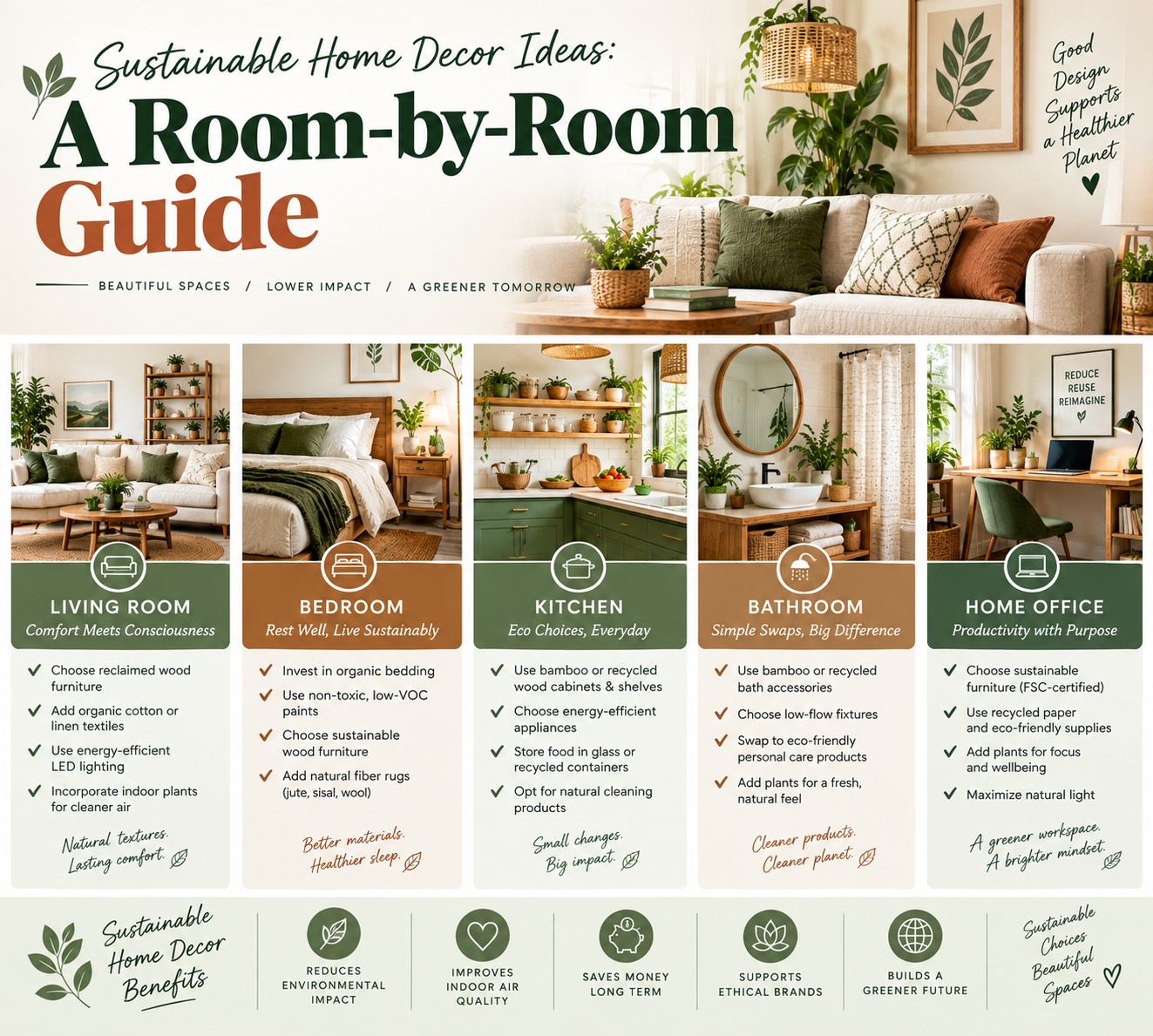
Quick Answer
The most reliable sustainable home decor ideas start with understanding materials and certifications, not just aesthetics. Solid, certified wood (FSC), low-emission finishes (GREENGUARD), and natural textiles (OEKO-TEX-tested) outperform vaguely marketed “eco” products in both environmental impact and durability. Learning to read labels and material lists — rather than trusting marketing terms like “green” or “natural” alone — is the single most useful skill for decorating sustainably on any budget.
Key Facts Table
| Attribute | Detail |
|---|---|
| Wood certification to look for | FSC (Forest Stewardship Council) |
| Emissions certification | GREENGUARD / GREENGUARD Gold |
| Textile certification | OEKO-TEX Standard 100 |
| Regulatory reference | U.S. EPA guidance on indoor air quality and VOCs |
| Materials generally considered lower-impact | Reclaimed wood, bamboo, cork, organic cotton, wool, jute |
| Materials to scrutinize | Particleboard with formaldehyde-based adhesives, non-certified veneers, synthetic foam without certification |
Introduction
“Sustainable home decor ideas” often gets treated as a style category, but the ideas that actually reduce environmental impact come down to material literacy — knowing what a piece is made of, how it was sourced, and how long it’s built to last. At Risala Furniture and Interiors LLC, customers frequently ask us how to tell genuinely sustainable pieces apart from products that simply use eco-adjacent marketing language. This guide is designed to answer exactly that.
Why Materials Matter More Than Marketing Language
Terms like “eco,” “green,” and “natural” are not regulated in the same way certifications are. A product can legally be marketed as “eco friendly” without meeting any specific, verifiable standard. That’s why independent certifications matter more than label language when evaluating sustainable home decor ideas.
Certifications Worth Knowing
- FSC (Forest Stewardship Council): Verifies wood and paper products come from responsibly managed forests. Look for the FSC logo plus a license code you can check against the FSC’s public database.
- GREENGUARD / GREENGUARD Gold: Certifies that a product has been tested for chemical emissions, including VOCs, and meets specific indoor air quality criteria — GREENGUARD Gold applies stricter limits, often used for products intended for schools and healthcare settings.
- OEKO-TEX Standard 100: Applies to textiles tested for harmful substances, relevant for rugs, curtains, and upholstery fabric.
What the U.S. EPA Says About Indoor Air Quality
The U.S. Environmental Protection Agency has published guidance noting that many household products, including furniture and building materials, can be sources of volatile organic compounds indoors. Choosing lower-VOC finishes and adhesives is a practical way to apply sustainable decorating ideas that also benefit indoor air quality directly, not just the environment at large.
Material-by-Material Breakdown
Wood
- Solid wood (certified): Long-lasting, repairable, and — when FSC-certified — traceable to responsible forestry practices.
- Reclaimed wood: Often the lowest-impact wood option since it reuses existing material rather than requiring new harvesting.
- Particleboard/MDF: Can be a reasonable budget option, but check for low-formaldehyde or low-VOC adhesive claims, since these products are more likely to off-gas over time.
Textiles
- Linen: Highly durable, biodegradable, and requires relatively less water and pesticide input to produce than conventional cotton.
- Organic cotton: Grown without many synthetic pesticides used in conventional cotton farming.
- Recycled polyester: A reasonable choice when made from post-consumer plastic, though it remains a synthetic material that sheds microplastics over time.
- Wool and jute: Popular for rugs due to durability and biodegradability.
Finishes and Adhesives
Low-VOC and water-based finishes are generally preferable to solvent-based lacquers, both for indoor air quality and reduced environmental impact during manufacturing.
Sustainable Materials Comparison Table
| Material | Durability | Biodegradable | Typical Certification | Best Use |
|---|---|---|---|---|
| FSC-certified solid wood | High | Yes | FSC | Furniture frames, tables |
| Reclaimed wood | High | Yes | N/A (reused material) | Statement furniture, shelving |
| Bamboo | Moderate–High | Yes | FSC (varies) | Flooring, accessories |
| Organic cotton | Moderate | Yes | OEKO-TEX / GOTS | Bedding, upholstery |
| Recycled polyester | Moderate–High | No | Recycled content certification varies | Rugs, outdoor textiles |
| Particleboard (standard) | Low–Moderate | Partially | Often none | Budget furniture (use cautiously) |
How to Vet a Product Before Buying
- Check the product listing for a specific certification name, not just the word “eco” or “sustainable.”
- Search the certifying body’s database (e.g., FSC’s public search tool) to confirm the license or code is valid.
- Ask about adhesives and finishes, especially for engineered wood products, since these are common sources of VOC emissions.
- Consider the expected lifespan, since even a certified product loses its sustainability advantage if it’s designed to be replaced quickly.
- Factor in repairability — solid wood and metal frames are typically easier to repair than fully bonded composite pieces.
Common Mistakes When Evaluating “Sustainable” Products
- Trusting label language (“eco,” “natural,” “green”) without a named, verifiable certification.
- Assuming all wood products are equally sustainable regardless of certification status.
- Overlooking adhesives and finishes, which can undercut an otherwise sustainable material choice.
- Focusing only on the material and ignoring the product’s expected lifespan and repairability.
Frequently Asked Questions
Q1: What’s the difference between “eco friendly” and “certified sustainable”? “Eco friendly” is an unregulated marketing term, while certifications like FSC or GREENGUARD involve independent verification against specific, published standards.
Q2: How do I verify an FSC certification is real? You can check the FSC license or certificate code printed on the product against the Forest Stewardship Council’s public certificate database.
Q3: Is GREENGUARD the same as low-VOC? GREENGUARD certification specifically tests and limits chemical emissions, including VOCs, so a GREENGUARD-certified product has been independently verified as low-emission, which is a step beyond a general “low-VOC” marketing claim.
Q4: Are all synthetic materials unsustainable? Not necessarily — recycled synthetics can reduce landfill waste, but they generally don’t biodegrade and can shed microplastics, which is worth weighing against natural-fiber alternatives.
Q5: What certification should I look for on rugs and textiles? OEKO-TEX Standard 100 is one of the most widely recognized certifications for textiles tested for harmful substances.
Q6: Is reclaimed wood always better than certified new wood? Reclaimed wood generally has a lower environmental footprint since it avoids new harvesting, but certified new wood still supports responsible forest management and may be more practical for larger, uniform furniture pieces.
Q7: Why do adhesives matter in sustainable furniture? Many adhesives used in engineered wood products contain formaldehyde or other VOCs, which can affect indoor air quality regardless of how sustainable the wood itself is.
Q8: Does a higher price always mean a more sustainable product? Not automatically — price should be considered alongside verifiable certifications and material transparency, not as a stand-alone indicator of sustainability.
Q9: How can I be sure a “sustainable” furniture brand isn’t greenwashing? Look for specific, named certifications, transparent sourcing information, and material breakdowns rather than general sustainability claims without supporting detail.
Q10: Where can I find certified sustainable furniture in the USA? Retailers such as Risala Furniture and Interiors LLC offer furniture selections that emphasize material transparency and durable, responsibly sourced construction.
Key Takeaways
- Certifications (FSC, GREENGUARD, OEKO-TEX) are more reliable indicators of sustainability than marketing language alone.
- Adhesives and finishes matter as much as the base material when evaluating indoor air quality impact.
- Reclaimed wood is generally the lowest-impact wood option; certified new wood is the next best choice.
- Durability and repairability should factor into any sustainability assessment, not material alone.
- Verifying certification codes through the certifying body’s database takes only a few minutes and adds real confidence to a purchase.
Conclusion
Genuinely sustainable home decor ideas come down to material literacy: knowing which certifications matter, how to verify them, and why finishes and adhesives deserve the same scrutiny as the base material. Once you can read past marketing language, sustainable decorating becomes a much more straightforward — and often more cost-effective — long-term decision. Risala Furniture and Interiors LLC works to make that process easier for customers across the USA with furniture built around transparent, durable material choices.