

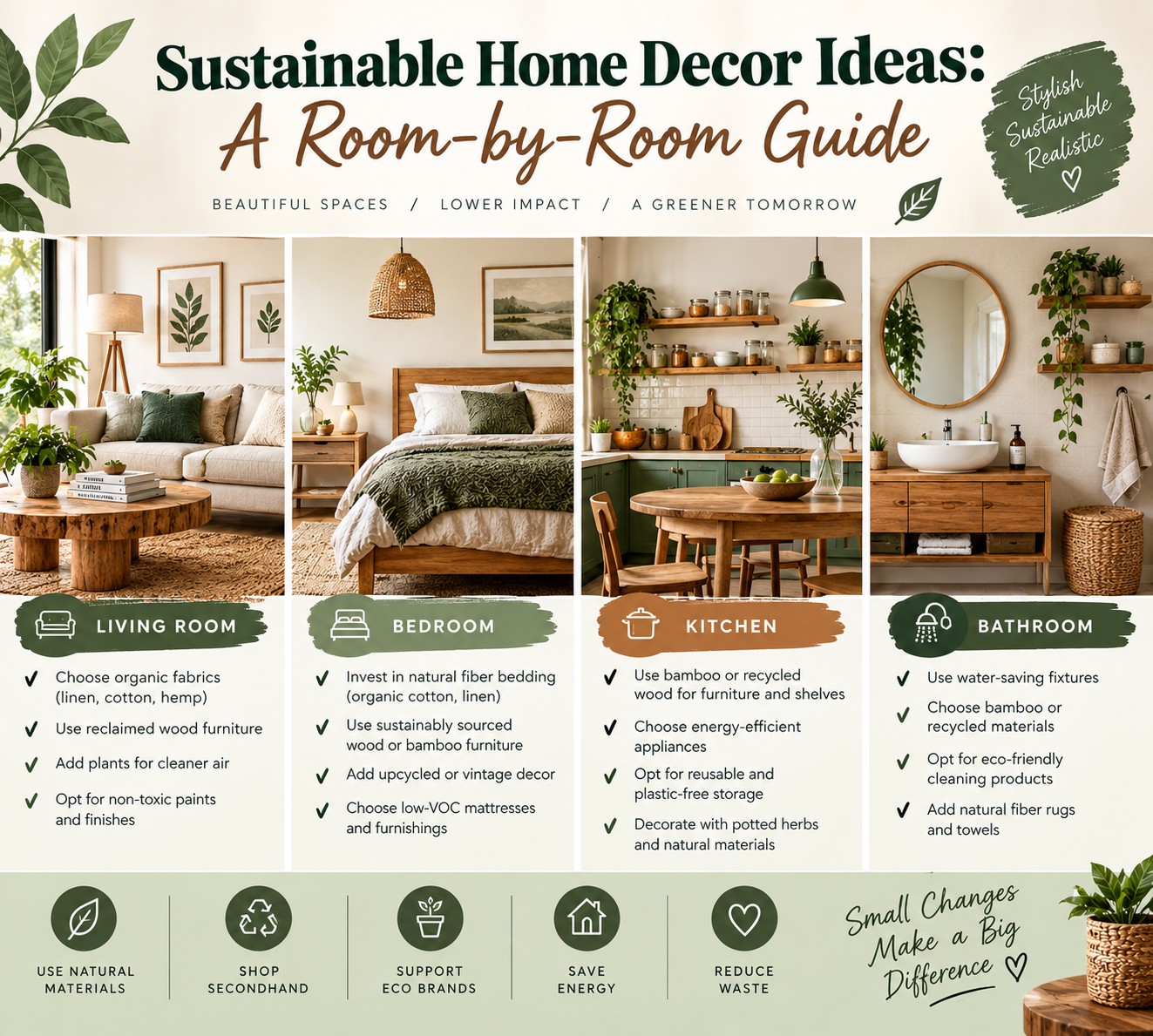
Quick Answer
Sustainable home decor ideas focus on reducing waste and environmental impact through smarter choices rather than buying more: repurposing existing furniture, choosing natural and certified materials, using energy-efficient lighting, and decorating with long-lasting pieces instead of trend-driven, short-lifespan items. The most effective sustainable decorating strategy usually starts with what you already own — refinishing, reupholstering, or repositioning existing furniture — before introducing new, responsibly sourced pieces.
Key Facts Table
| Attribute | Detail |
|---|---|
| Core principle | Reduce, reuse, then responsibly replace |
| High-impact swaps | LED lighting, natural-fiber textiles, low-VOC paint |
| Materials to prioritize | Reclaimed wood, bamboo, cork, jute, wool |
| Certifications to check | FSC (wood), GREENGUARD (emissions), OEKO-TEX (textiles) |
| Rooms with easiest sustainable wins | Living room (textiles/lighting), kitchen (linens, storage) |
| Common pitfall | Buying new “sustainable” items instead of reusing existing ones |
Introduction
Sustainable home decor ideas often get reduced to a shopping list — buy this bamboo lamp, swap in that jute rug — but the most effective approach usually starts before you buy anything at all. It starts with an honest look at what’s already in your home and how it can be extended, repaired, or repurposed. At Risala Furniture and Interiors LLC, we work with homeowners across the USA who want their space to look intentional and current without contributing unnecessarily to furniture waste.
This guide covers sustainable decorating ideas room by room, along with the reasoning behind each one, so you can prioritize based on your budget and timeline.
Living Room Ideas
1. Reupholster Instead of Replacing
A worn sofa frame in good structural condition can often be reupholstered in natural linen or cotton for a fraction of the cost of a new sofa, while extending its life by another decade or more.
2. Choose Open Shelving Over Closed Cabinetry
Open wall shelving, especially in solid wood, tends to use less material than large cabinet units and creates a lighter, more adaptable display space that can evolve with your decor over time.
3. Swap to Natural-Fiber Textiles
Jute rugs, wool throws, and linen cushion covers are biodegradable and generally more durable than synthetic alternatives, which shed microplastics over their lifespan.
4. Switch to LED Lighting
LED bulbs use significantly less energy than incandescent bulbs and last many times longer, reducing both electricity use and bulb-replacement waste.
Kitchen and Dining Ideas
5. Use Reclaimed or Certified Wood Dining Furniture
Reclaimed wood tables carry visible character — knots, grain variation — while avoiding the environmental cost of newly harvested timber. Where new wood is preferred, FSC certification indicates responsible forestry sourcing.
6. Replace Paper and Plastic with Reusable Textiles
Cloth napkins, reusable produce bags, and natural-fiber placemats reduce single-use waste while adding texture to a dining space.
7. Choose Ceramic and Glass Over Plastic Storage
Glass jars and ceramic containers are reusable indefinitely and don’t degrade with heat or time the way many plastics do.
Bedroom Ideas
8. Invest in Organic Cotton or Linen Bedding
Organic cotton is grown without many of the synthetic pesticides used in conventional cotton farming, and linen is prized for durability, often lasting decades with proper care.
9. Add a Statement Wood Headboard
A solid wood headboard, especially reclaimed or certified, adds visual warmth and tends to outlast upholstered alternatives that wear down faster.
10. Use Low-VOC Paint for Walls
Bedroom air quality matters given the hours spent sleeping in the space; low-VOC paints reduce off-gassing compared to conventional options.
Home Office Ideas
11. Choose a Solid Wood Desk Over Particleboard
Solid wood desks are typically repairable and refinishable, while particleboard desks are harder to repair and more likely to be discarded after damage.
12. Add Greenery for Both Air and Aesthetics
Houseplants are a low-cost way to soften a workspace, though they should complement — not replace — material and sourcing choices elsewhere in the room.
Sustainable Decor Ideas: Quick Comparison
| Idea | Upfront Cost | Environmental Benefit | Effort Level |
|---|---|---|---|
| Reupholster existing sofa | Moderate | High (avoids new manufacturing) | Moderate |
| Switch to LED lighting | Low | Moderate–High (long-term energy savings) | Low |
| Buy reclaimed wood furniture | Moderate–High | High | Low (if buying ready-made) |
| Swap to natural-fiber textiles | Low–Moderate | Moderate | Low |
| Refinish existing wood furniture | Low | High | Moderate–High (DIY effort) |
A Practical Starting Framework
- Audit what you already own. Identify pieces worth restoring versus replacing.
- Prioritize high-use rooms first. Living rooms and bedrooms typically offer the most noticeable impact for the effort involved.
- Replace only what’s necessary, choosing certified materials where new purchases are unavoidable.
- Layer in textiles and lighting last — these are typically the lowest-cost, highest-visual-impact sustainable swaps.
Common Mistakes to Avoid
- Treating “sustainable decorating” as a reason to buy more, rather than a filter for buying less and better.
- Discarding usable furniture instead of restoring it.
- Choosing greenwashed products marketed as “eco” without any verifiable certification or sourcing information.
- Overlooking energy use (lighting, appliances) in favor of only material choices.
Frequently Asked Questions
Q1: What is the cheapest way to start decorating sustainably? Switching to LED lighting and reusing or refinishing existing furniture are typically the lowest-cost, highest-impact starting points.
Q2: Are sustainable home decor ideas only about materials? No — energy use (lighting, appliances), durability, and how long you keep a piece before replacing it all factor into overall sustainability.
Q3: Is reupholstering furniture actually more sustainable than buying new? Generally yes, since it avoids the manufacturing and material extraction required for an entirely new piece, provided the existing frame is structurally sound.
Q4: What’s the most sustainable material for a rug? Natural fibers like jute, wool, and sisal are commonly favored for their biodegradability and durability compared to synthetic rug materials.
Q5: Do sustainable decor ideas work for renters? Yes — many ideas, like swapping textiles, adding LED bulbs, and using freestanding rather than built-in furniture, require no permanent changes and suit rental properties well.
Q6: How can I tell if a “sustainable” product is genuinely eco friendly? Look for recognized certifications such as FSC (wood), GREENGUARD (emissions), or OEKO-TEX (textiles) rather than relying on marketing language alone.
Q7: Does sustainable decorating mean sacrificing style? No — sustainable principles can be applied to virtually any design style, from minimalist to traditional to eclectic.
Q8: What sustainable decor idea has the biggest visual impact for the lowest cost? Natural-fiber textiles (rugs, cushions, throws) tend to offer a strong visual refresh relative to their cost and environmental footprint.
Q9: Should I prioritize sustainable furniture or sustainable textiles first? If budget is limited, textiles and lighting typically offer faster, lower-cost wins, while furniture replacement can be planned over a longer timeline.
Q10: Where can I find sustainably made furniture and decor in the USA? Retailers like Risala Furniture and Interiors LLC offer furniture selections designed with durability and responsible sourcing in mind for customers across the USA.
Key Takeaways
- Sustainable decorating starts with reusing and restoring what you already own.
- LED lighting and natural-fiber textiles offer the fastest, most affordable sustainable upgrades.
- Certifications like FSC and GREENGUARD are more reliable indicators than marketing claims.
- Prioritize high-use rooms first for the most noticeable impact.
- Sustainability is a filter for smarter purchasing, not a reason to buy more.
Conclusion
Sustainable home decor ideas work best as a mindset shift rather than a shopping spree — reuse and restore first, then replace thoughtfully with certified, durable materials where needed. Small changes like lighting and textiles can deliver a noticeable refresh at low cost, while bigger investments like solid wood furniture pay off over a much longer lifespan. Risala Furniture and Interiors LLC supports homeowners across the USA with furniture and decor built to last, making it easier to decorate sustainably without compromising on style.